Dyscorpia: Future Intersections of the Body and Technology, Enterprise Square Galleries, Edmonton, AB, April 23 – June 30, 2019
Evolving Anatomies, Ottawa School of Art, Shenkman Arts Centre, Ottawa, ON, 2019
Embodiment, Espace Corps Secrets, Montréal, QC, 2020
← Works
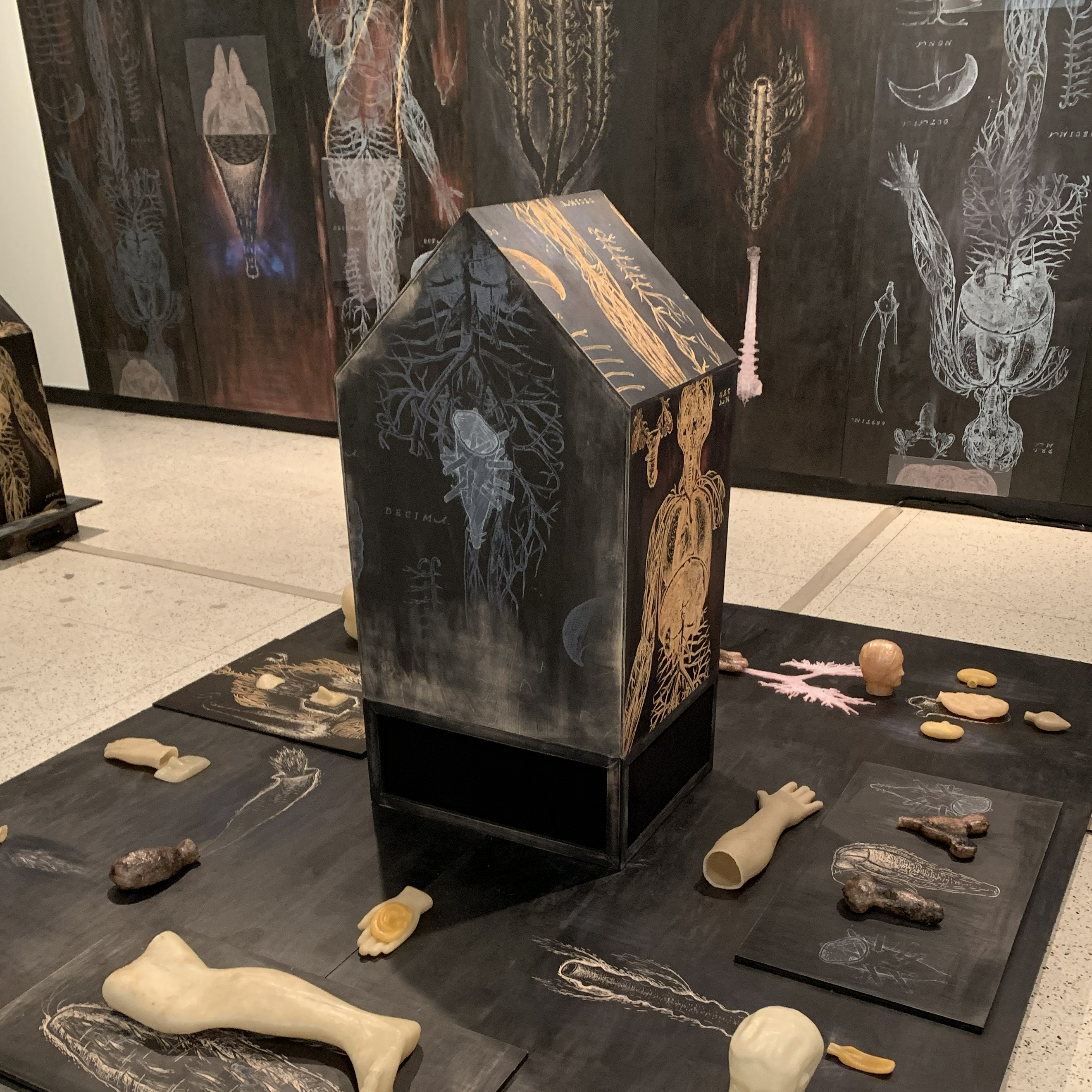
Evolving Anatomies (2019) is a large mixed-media installation created by Sean Caulfield, Marilène Oliver and Scott Smallwood. It is a wall of images that sets anatomical representations from the Renaissance against those of the present day, letting five centuries of ways of seeing the body collide and combine. Caulfield's starting point was the "Vesalius man," drawn from the anatomical plates of Andreas Vesalius, the sixteenth-century father of modern anatomy. Oliver's was Melanix, an open-source, full-body CT scan of a woman. Caulfield's woodcuts and drawings are overlaid with Oliver's screen prints and video projections of CT scan data, built up in layers of carved maple, screen-printed polycarbonate, laser-cut acrylic and plywood. At the base of the wall, wax arms and legs recall the Catholic tradition of leaving wax casts of ailing body parts as offerings at healing shrines such as Lourdes.
Smallwood infuses and surrounds these objects with a multichannel soundscape of flowing water, heat, melting ice, bells, and data-driven textures. Through it drift secret messages, glitches and distorted broadcasts, like fragments of a signal passing through the body, or through the machines that now image it.
The work draws on Daniel Laforest's research at the University of Alberta into the ways medical technology, and diagnostic imaging in particular, are changing how we perceive and understand our own bodies and life stories. It also comments on the growing gap between wealthy nations and communities, which have easy access to cutting-edge digital health technology, and poorer ones, which do not. As biomedical innovation accelerates, that gap raises urgent ethical and political questions about who benefits, and about how health and digital technologies are shared. Placing the hand-carved body of the Renaissance beside the scanned body of the present, and the votive offering beside the CT scan, the installation asks what we now place our faith in to heal us.
Evolving Anatomies was exhibited in Dyscorpia: Future Intersections of the Body and Technology at Enterprise Square Galleries, Edmonton, in 2019.
PremieredApril, 2019, Dyscorpia, Enterprise Square Galleries, Edmonton
Performance / Exhibition History